Sally Williamson & Associates
Our Methodology
Our Methodology: Content, Style, and Situation, Together
How we can help
Three Dimensions. One Framework. Spoken Communication That Works Every Time.
Our Methodology
Communication touches everything. Every meeting, every presentation, every impression that quietly builds up around you over time. And most people never stop to think about it as a skill they can actually improve.
Most training doesn’t help much either. It picks one piece and stops there. A workshop on presentation skills. A seminar on executive presence. But that’s not how communication works. What you say and how you say it are connected, and both have to shift depending on where you are and who’s listening.
So we built our communication skills methodology around three dimensions instead of one: content, style, and situation.
Content:
What You Say
Most listeners give you about 30 seconds to set a message and a direction. Thirty seconds. That’s the window before people start deciding whether to lean in or check out.
We teach how to organize a storyline, build a message that’s actually compelling, and use stories that make the sound bites stick. Good data points align with the brain. Good stories align with the heart. If you can hit both, you have a much better shot at getting results.
Connecting Stories to Storylines
Strong stories are most effective when they support a clear message. This interactive program helps participants organize ideas, build a focused storyline and use relevant stories to make key points easier to understand, remember and repeat. Participants leave with a practical framework they can apply to important business conversations, recommendations and leadership messages.
Leading Executive Conversations
Executive audiences want the bottom line quickly. This practical program helps participants organize high-level conversations around a clear message, communicate the value or decision up front and adjust to an executive’s knowledge and interest. Through role play and coaching, participants build the structure and confidence to lead executive conversations more effectively.
Bringing Content & Style Together
Strong communication depends on both what you say and how you say it. This focused one-day program helps participants sharpen their message, strengthen their presence and bring content and style together more intentionally. Designed for professionals with foundational communication skills, the course provides practical fine-tuning they can apply immediately in important business conversations.
Style:
How You Say It
Style is presence. It’s the ability to walk into a conversation, or a room, and have people lean toward you instead of away.
Look closely at people who seem confident, and you’ll notice it’s not an accident. It’s an open, settled body. A full, measured tone. That’s why they get heard when they speak and noticed when they walk in. And confidence isn’t just a leadership trait. It’s a differentiator for anyone who wants their personal brand to carry weight.
We teach the intentional choices behind those impressions, not just the impressions themselves.
Strengthening Personal Brand & Impressions
A personal brand is built through the impressions others form in everyday business interactions. This interactive program helps participants understand how their voice, body language and presence influence those impressions. Through practical tools and focused feedback, participants learn to communicate with greater confidence, credibility and intention while remaining authentic to who they are.
Mastering Executive Presence
Executive presence is not a technique. It is the confidence, competence, commitment and authenticity that lead others to trust your voice and your ability to lead. This advanced workshop helps participants strengthen how they engage a room, project their message and influence an audience with greater intention.
Situation:
Where It Comes Together
Here’s the part most training skips. The tools stay the same, but the situations never do.
You think about a small group differently than you think about a keynote. You think about a meeting built for discovery differently than a recommendation built for approval. A conversation with the board isn’t a team stand-up, and a sales conversation isn’t a career-defining presentation.
That’s the third dimension. It’s what moves someone from being competent with their skills to being consistent with their outcomes. We don’t just teach the fundamentals. We help you apply them to the moments that actually matter to you.
Handling the Q&A
Strong answers require more than knowing the subject. This workshop helps participants think on their feet, anticipate audience questions and respond with clarity and focus. Using SW&A’s three-step process, participants learn to manage questions confidently, expand on key ideas and guide conversations toward the outcome they want.
The Virtual Communicator
Feedback is most effective when it becomes a development conversation, not simply a review of what went wrong. This practical program helps leaders prepare a clear message, communicate with confidence, manage resistance and guide individuals toward ownership, accountability and stronger results.
The Master Storyteller
Powerful stories help leaders simplify complex ideas, create connection and make important messages more memorable. This advanced program helps participants understand the structure behind effective storytelling while strengthening the authenticity, confidence and presence that bring a story to life. Participants learn to use stories with greater intention to engage audiences, build empathy and reinforce the ideas they want others to remember.
Stewarding Your Career
Executive audiences want the bottom line quickly. This practical program helps participants organize high-level conversations around a clear message, communicate the value or decision up front and adjust to an executive’s knowledge and interest. Through role play and coaching, participants build the structure and confidence to lead executive conversations more effectively.
Manager to Leader
Moving from manager to leader requires more than a change in title. This practical workshop gives seasoned managers a clear playbook for building the skills, relationships and team dynamics needed to lead with confidence. Participants learn how to set direction, align people around action and guide teams toward stronger outcomes.
Delivering Effective Feedback
Feedback is most effective when it becomes a development conversation rather than a review of what went wrong. This practical workshop helps managers communicate feedback clearly, respond to resistance and distinguish between skill gaps and behavior issues. Through discussion and role-play, participants learn how to guide conversations that build understanding, accountability and stronger results.
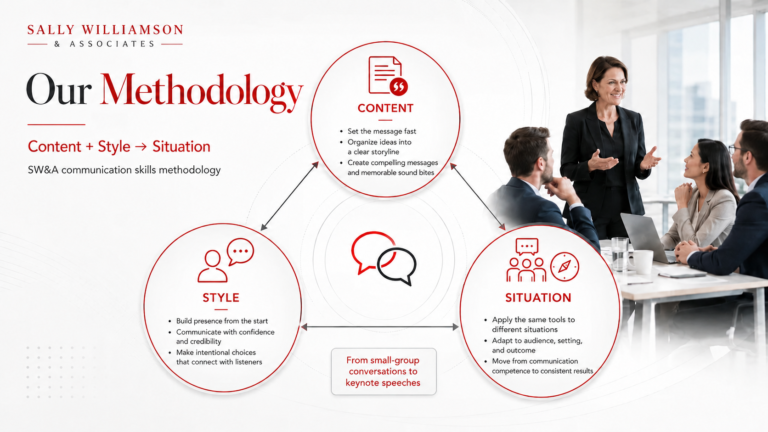
The Content + Style + Situation Framework
Here’s what we’ve learned after thirty years of doing this. A program works best when it gives people the tools to organize their thoughts and deliver them with impact, and then tailors both to the situations that actually matter to the people in the room.
That’s the formula. Not content alone. Not style alone. Both, applied to real life.
What sets us apart is the bench behind it. Our coaches don’t just hand you a technique and walk away. They share the intent behind the communication, so you understand why it works and not just how to repeat it. That’s the difference between a skill you perform once and a skill you carry with you.
Content is the substance of your message, the ideas and information you want an audience to remember and act on. We help you sharpen what you say so it lands with clarity, carries a clear point of view, and drives to the outcome you need.
Style is how you show up when you deliver your message, from presence and pacing to the way you connect with a room. We help you develop a delivery that feels authentic to you and commands attention, so the way you communicate strengthens what you have to say.
Situation is the context around your message, including the audience, the stakes, and the setting you are walking into. We help you read each moment and adapt your approach so you are prepared for the boardroom, the town hall, or the high-pressure conversation that defines a career.
numbers
Results
Learn more
Frequently Asked Questions
Most training programs focus on delivery alone, or on messaging alone. Our methodology develops content, style, and situation together, because that’s how real meetings, presentations, and conversations actually play out.
Content is what you say. Style is how you say it. Situation is the context you’re speaking into, including the audience, the stakes, and the moment. All three shape whether a message actually lands.
Executives, emerging leaders, sales teams, and corporate teams. The framework flexes to fit where someone is in their career and what they’re working to achieve.
Yes. The same framework applies to meetings, executive conversations, sales situations, and everyday leadership moments, not just formal presentations.
Over 30 years, refined through direct work developing spoken communication with leaders at Fortune 500 companies.
Yes. We offer custom corporate workshops that apply the same framework at a team or organizational level.
Yes. The same content, style, and situational principles apply in virtual settings. Coaching can address camera presence, vocal delivery, message structure, engagement, and communication across hybrid and remote environments.
Communication training helps leaders translate expertise into influence. It strengthens their ability to align teams, guide decisions, build trust, lead change, and communicate with confidence across the organization.